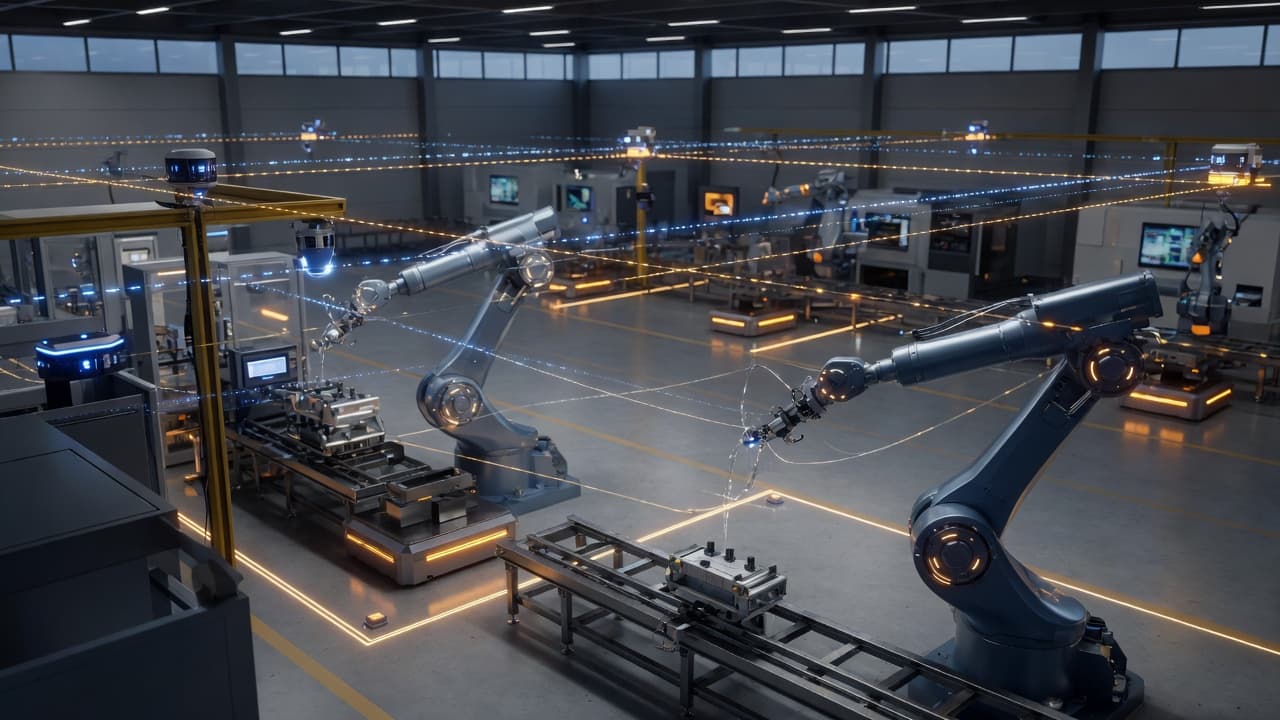
Many manufacturers have already connected equipment to the network. Fewer have turned that connectivity into a durable operational advantage.
The gap is almost always in how data is used — not how many sensors were installed.
From raw sensor data to real-time visibility
Connecting sensors is only step one. Value appears when plant managers can act during a shift, not only review reports after the fact.
That means:
- Reliable data ingestion and time-series storage
- Role-specific dashboards (operators, supervisors, maintenance)
- Clear thresholds and alerts with low noise
- Context from production orders and quality systems
Predictive maintenance beats calendar maintenance
Models trained on vibration, temperature, load, and usage patterns can flag failures before they stop a line.
Benefits typically include:
- Fewer unplanned stoppages
- Less unnecessary scheduled maintenance
- Better spare-parts planning
- Higher overall equipment effectiveness (OEE)
Start with one critical asset class, prove value, then scale.
Edge processing for time-sensitive decisions
When milliseconds matter, round-tripping every signal to the cloud is not enough.
Edge processing keeps local automation responsive even when WAN connectivity is imperfect, while the cloud remains ideal for training models and long-horizon analytics.
Closing the loop with automation
Mature IIoT deployments do not stop at dashboards. They close the loop:
- Open maintenance tickets automatically
- Adjust machine parameters within safe bounds
- Notify operators in real time
- Feed quality systems when drift is detected
Human oversight remains essential — automation should accelerate response, not hide accountability.
Security and OT/IT convergence
Connecting plant systems expands the attack surface. Design for:
- Network segmentation between OT and IT
- Identity and remote-access controls
- Patch and asset inventory discipline
- Monitoring for anomalous device behavior
A smart factory that is not secure is a high-risk factory.
A practical adoption path
- Pilot one line or asset family with clear KPIs
- Integrate historian/MES/ERP context
- Add predictive models and edge rules
- Automate high-confidence responses
- Scale with standard architectures and playbooks
Key takeaway
The manufacturers getting the most from IoT are not the ones with the most sensors. They are the ones who built analytics, security, and automation to act on what those sensors say.
If you are planning an IIoT program — from pilot to plant-wide rollout — we can help design the architecture, integration approach, and operating model for measurable results.